To celebrate Mega Man's 25th anniversary in style, I got together with my longtime friend (codename Dash Jump) and my wife (alias Z-Saber) to stream over 20 continuous hours of Mega Man over the Internet, with viewers from all around the world tuning in at various times to join in the fun. What began as a televised second helping of my 2010 Mega Man marathon soon became a more massive undertaking and learning experience than I had ever expected.
Our marathon comprised Rockman 1-6 for the Famicom (both because we'd never played the original Japanese versions of the NES games, and because the Famicom A/V was easier to stream from), Mega Man 7 for the SNES, Mega Man 8 for the PS1, and Mega Man 9-10 for the Wii. If you missed any part of the marathon, or if you'd like to relive the memories, pay a visit to any of the links below—the whole thing is saved there for future generations to look at it and say, "What were you guys thinking!?"
- Dash's Twitch TV channel
- Dash's Megathon playlist on his YouTube channel
- My Collaborations playlist on my YouTube channel
I'm giving Dash all the credit here [Dash's note: I accept all the credit!]—I might've come up with the idea, but he's the one who provided the hardware and expertise that allowed us to stream ten different games on four different consoles from the comfort of my living room. Not only that, but he did an excellent job of moderating the viewer chat room—something I mostly gave up on after I started getting a headache from looking back and forth between the gameplay on my television and the text scrolling by on his laptop.
I also was pleased and grateful to have my wife there throughout the first nine games; she, too, kept on top of the chat room, and was even a good enough sport to play a stage or two when the fans requested it. Additionally, she volunteered to make pizza from scratch when dinnertime drew near. (It was delicious, I might add.)
I mentioned this was both a learning experience and a more massive undertaking than anticipated; perhaps the best way to illustrate what I mean is with a few lists.
What went well:
- Technology! We actually managed to pull this off with no significant technical difficulties, unlike the first time I tried to record Mega Man videos. This is why Dash is the man. [Dash's note: Agreed; he is also handsome and single.]
- Publicity! Not only did Dash find numerous opportunities in the chat room, in the commentary, and in the video footage (with pre-created images posted between games) to advertise our Twitter accounts, but my efforts to plug the marathon on Exfanding, Facebook, YouTube, and Twitter were very successful in drawing more of a crowd to advertise to in the first place. [Dash's note: We love you; please follow!]
- Breaks! When one of us needed to eat or step out of the room for whatever reason, the other could keep playing to cover for us, so there was seldom a break in the action. This also helped limit the amount of down time between games; aside from swapping out cartridges and systems, we rarely needed more than a minute or two until we were ready to roll again.
- Commentary! We were, at various times, thoughtful, insightful, clever, funny, and generally entertaining. Even as the marathon dragged on and we slogged through the games and stages we weren't as fond of, we often managed to stay chatty and keep a positive attitude (or at least sound like we had a positive attitude).
- Responsiveness! Between the three of us, someone was always monitoring the chat room, and we tended to be very good about responding to the questions and requests of our viewers.
- Gameplay! There was a solid mix of impressive success and hilariously embarrassing failure in our playing, with plenty of fun, tense, and enlightening moments interspersed between the biggest highlights. [Dash's note: I have a keen sense for dodging into pits and spikes.]
- Food! We had breakfast, lunch, and (to a lesser extent) dinner planned out in advance, with plenty to drink and snack on whenever we needed it. [Dash's note: Except chocolate ice cream, because Gemini hoarded it all.]
- Participation! All three of us were frequently and meaningfully involved in various aspects of the marathon.
- Completion! We actually beat all ten games. How 'bout that.
What could have gone better:
- Starting! We told everyone we'd begin around 8:00 AM; we started closer to 8:20 AM. That's not too far off when you're talking about an all-day marathon, but we probably could have put up the "preloader" screen in time for the people who showed up early to be reassured that this was still happening.
- Alertness! I was apparently still groggy and especially off my game through Rockman 1-2, and it took Dash a few hours until he realized he hadn't had his coffee. Needless to say, our performance at the beginning, while still entertaining, often left something to be desired. It took us 25 minutes just to beat Ice Man's stage—which, I might point out, is how long it took us to beat all five of the preceding robot masters combined. This prompted our favorite recurring gag of the marathon, a series of Zelda II-inspired "GAME OVER RETURN OF ICE MAN" images that stemmed from the chat room's response to our world-condemning failures. [Dash's note: Ice Man has haunted my dreams since Monday.]
- Expectations and timing! My previous marathon—which was interrupted for 45 minutes by an unexpected errand, had a few longer breaks, and involved me collecting basically all the optional bolts in Mega Man 8—clocked in at about 16 hours. Even allowing 17 hours for this marathon would surely be more than sufficient, bringing the event to a close by around 1:00 AM at the latest. That's late, to be sure, but not an hour at which either of us is unaccustomed to being functional.
We ended at 4:00 AM. Our breaks between games were almost nonexistent, we skipped half the bolts in Mega Man 8, and we finished three hours later than the latest I was prepared for.
Our original plan was to have me be the primary player for all ten games, with Dash occasionally jumping in on the games he was more experienced with. While classic Mega Man and platformers in general are my specialty (and the ten games we marathoned were still fresh in my mind from my YouTube videos and my 2010 marathon), Dash is better at the Mega Man X series and other genres of games. [Dash's note: True dat.] I think we both recognized that, while it might be more fun to share the marathon equally, things would probably flow better if I covered for Dash on the games he'd only played once, or too long ago to remember well.
Neither of us discussed changing the plan. When I kept offering him the controller after beating a stage, and he kept accepting, the marathon transformed from a relaxed speedrun of Mega Man 1-10 into a casual "Let's Play" of Mega Man 1-10 with no definite endpoint. The whole point was to have fun playing these games together, but I was so focused on how far behind schedule we were that I could barely let either of us enjoy the marathon fully. It wasn't long before I started hammering Dash with unwelcome, unsolicited advice [Dash's note: And don't forget the rolled-up newspaper!] about how to get through each stage more quickly, and even my theater background couldn't mask my unhappiness with fighting Clown Man after my bedtime.
Lessons learned:
- Understand the person or people with whom you're collaborating, and be attentive to their mood, playing style, and gaming ability. Create a plan, agree on the plan, stick to the plan. Clearly communicate your expectations to each other, and clearly express when things aren't meeting your expectations or going as planned. [Dash's note: Is this marriage advice?] I could go into more detail here, but suffice it to say that almost everything that could've gone better with the marathon was the result of us doing the opposite of everything mentioned above.
- For future marathons, Mega Man & Bass should be played in place of Mega Man 8. Unrelenting difficulty be darned! Anything's gotta be better than...well, pretty much everything about that game.
- Unless it's an intentionally blind playthrough or a spontaneous decision to play a particular game, spend a little time before the marathon/livestream practicing or reading up on the game(s) you're going to play. This is especially important if there are known trouble spots—dodging the shots of Mega Man 7's final boss, for example, or the labyrinth sections of Astro Man's stage in Mega Man 8.
- I am not cut out for livestreaming on my own; this would have been a complete disaster without Dash. [Dash's note: Most things are a complete disaster without Dash.] Simultaneously monitoring the chat room, providing commentary, actually playing a game, periodically advertising my various social media accounts, and ensuring the technology still works is not something I can see myself happily or competently doing.
- Never forget how awesome your viewers are. A handful of people spent the entire 20 hours with us. Some of our viewers went to bed, and came back seven or eight hours later to see if we were still playing. We had people digging up articles, video links, and even creating custom images for us on the fly. It didn't matter that we scored dozens of Game Overs or accidentally had to replay half of the castle stages in Mega Man 9; our viewers were there for us, and that's a magnificent feeling.
Overall, despite the fatigue, failure, and frustration I know we both suffered at certain points (GAME OVER RETURN OF ICE MAN), I'd say the Megathon (as Dash likes to call it) was a great success. We provided the Internet with 20 more hours of entertainment, Dash's livestreaming career is off to a strong start [Dash's note: Thanks, Gemini!!!], we both gained more subscribers and followers, and we got to celebrate Mega Man's 25th anniversary in style, among friends both near and far.
Now, to start planning that Mega Man Game Boy marathon...
Showing posts with label World Languages. Show all posts
Friday, December 21, 2012
Tuesday, January 5, 2010
Exfanding Review: Seven Samurai
This past Wednesday, Nathaniel, guest poster neko-chan, and I celebrated the comic book skip week in a fitting way--we continued the plunge into our brand-new fandom: the films of Akira Kurosawa. For our fifth and final formal foray into the work of the internationally famous Japanese filmmaker, we watched Seven Samurai, which was the longest--and generally best-liked--of the films we've seen so far.
Let's start with the obligatory, what was Seven Samurai about question, shall we?
Alex: Sounds good. Seven Samurai is about a small farming village that is on the verge of being wiped out by violent rebels. At their collective wits' end, and terrified of what the future may hold, the villagers seek advice from their elder, who tells them to hire samurai to help defend their home.
After being rejected by many different samurai, one finally agrees to help--accepting payment in food because he is a noble soul. This samurai, named Kambei, immediately sets out to find others to help him defend the village.
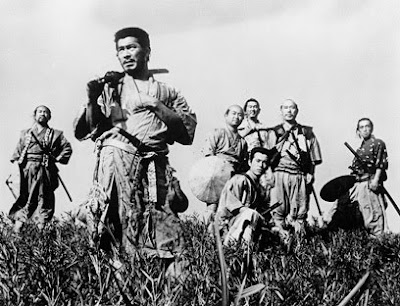
Kambei, along with four other seasoned ronin, one young samurai apprentice, and a farmer (Kikuchiyo, played by Toshiro Mifune) whom they accept as a samurai, become tasked with training the villagers and preparing them for the imminent attack from the rebels.
The battle between villagers and rebels comes in the last hour or so of the film, and leads to...
[SPOILER ALERT]
----
----
----
----
...the samurai and the villagers defeating the rebels and successfully defending their village. [END SPOILERS]
Nathaniel: Yeah, I don't think there's anything I need to add here.
What modern film/films might you compare Seven Samurai to?
Alex: Well, the obvious answer is The Magnificent Seven, which was based on Kurosawa's epic. But that film was made in 1960, just six years after Samurai. No, I'm gonna go with (and I know this is cheating, since it was a book first), The Lord of the Rings: The Two Towers. Interestingly, Tolkien's second book in the trilogy was written in 1954, the same year that Kurosawa's film was released in theaters.
It's a coincidence, sure, but a pretty cool one.
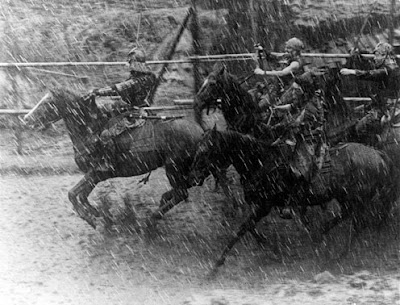
I'll speak mostly to the film version of Two Towers, though, because as we watched Samurai, I kept thinking about Peter Jackson, and that film. Much of Samurai is spent anticipating the attack from the rebels. We're in the (now fortified, thanks to the samurai) village, and as the film moves along, we grow just as anxious as the villagers, awaiting the battle.
This was done very effectively, and it really helped put me in the film.
I got a similar feeling while watching Two Towers--that pit in my stomach I developed while thinking about putting myself in the position of one of the fighters. What must it be like days and days before the battle, not knowing exactly when the enemy will strike? Or how about when you finally see the enemy on the horizon, lined up in rows and rows, and you know you're outnumbered?
Kurosawa was able to build up the anticipation for the final battle, and the end result was perfect. Just like in Two Towers, the final battle in Samurai was epic and wonderfully choreographed and filmed.
Nathaniel: What he said.
Compare this Kurosawa film to the others you've seen.
Alex: Um, that's not a question. But OK. While I previously stated that Rashomon was my favorite of the five movies we've watched, I need to change that answer. I was totally engrossed in Samurai, from beginning to end. Considering it's an over-three-hour long film, that's saying something, especially with my modern, "let's blow some stuff up and go home" movie-going sensibilities.
Nathaniel: It's strange; of the five films we watched--and please allow me to explain what I mean before you get upset--Seven Samurai was the least distinctive. My experience of The Hidden Fortress was characterized by a lot of "Whoa! I've never seen that in a '50s movie!" moments; Ran was extremely colorful and had a tremendous amount of exposition; Yojimbo felt very much like a Japanese cowboy movie; Rashomon felt very much like a stage play, but Seven Samurai... Maybe I haven't had enough time to reflect on it yet, but no single aspect of the movie stood out as heavily as anything I saw in the other films, but that's by no means a bad thing.
Seven Samurai was not so much a movie as it was an expertly crafted story that happened to have been told through the medium of film. In the other four movies, I'd occasionally pick out specific elements such as a particular actor's performance or a unique camera shot that would take me out of the movie a little bit because I felt moved to analyze it on the spot.
Not so with Seven Samurai; though there is much to analyze, the whole production was organic and subtle, never overdone nor underdone, and every element worked together in brilliant harmony to keep me enraptured in the movie the entire time, or at least until I started to get hungry all of 10 minutes before the built-in intermission.
What is so appealing about this movie?
Nathaniel: Though there are so many good and great things about this film, I think its popularity is most likely rooted in the story: People love a great underdog story, and the characters are wholly relatable--most anyone can identify with the everyday villagers, and the heroes, while so much more talented in combat than any of the villagers could hope to match, are still human. The story stirs up feelings of oppression, fear, hope, and freedom, and those are universal themes.
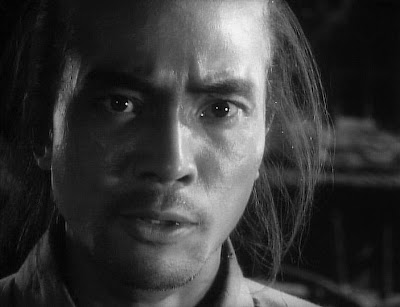
Alex: The story kept me engaged, the acting was great--again, Mifune shined in his role as haunted farmer/samurai--and I was completely wrapped up in the film. I can't really say much more than that.
This film was the longest of all the Kurosawa films we've seen; was it difficult to stay focused and awake the whole time?
Nathaniel: Amazingly, no. My attention span for movies has been dwindling in my old age, but I can still stomach longer movies if the pacing is good.
Seven Samurai gets an A+ for pacing.
Throughout the entire film there was a building sense of progress and anticipation; more and more samurai joined the cause of the villagers, battle preparations continued, and the time to fight drew nearer all the time. Every time the tension and unnerving calmness reached the verge of being too much to bear, a little skirmish would break out or a situation would arise to push the story forward. I was focused and attentive a greater percentage of the time than I was for any of the previous films, including the shorter-than-average Rashomon, which I had previously believed to have the best pace out of any of them.
Alex: Before we sat down to watch the flick, I told Nathaniel that, if he sees my eyes closed and hears snoring-like sounds coming from my end of the couch, it's because I am very focused on the movie. And that's how I show focus.
It's funny, because Nathaniel and I had a habit of talking through the slower parts of some of these movies. There were whole chunks of Ran that we gabbed through, for instance, but other than a few comments at the start of Samurai (and one hilarious comment somewhere in the middle of the film about a bear), we were all pretty wrapped up in the movie.
Did anything surprise you about this film?
Alex: Lots of things, actually. I was pretty terrified of sitting through a three-plus hour flick, especially since some of the other films we watched tended to drag in places. I was pretty shocked at how deeply involved in the film I got.
Nathaniel: Spoiler alert and all that, but... people die. And not just anybody. People with names. Good guys and bad guys alike. Sometimes it was oddly poetic, and sometimes it was tragic, but nothing ever happened strictly for shock or entertainment value. The story never felt forced in that regard--when it was someone's time to go, it was because the sequence of events had led to that point, not because it seemed like a good idea at the time.
How did Toshiro Mifune's performance here compare to what we saw in the previous four films?
Alex: Boy, he plays such a wide range of characters in these movies, it's really amazing. It seems like the most difficult part in each movie goes to Mifune, and he always handles the roles with the utmost skill.
In Samurai especially, Mifune balanced a somewhat maniacal, sometimes drunken demeanor with this sense of nobility and honor. It was quite an impressive performance.
Nathaniel: Each of the roles we've seen has had something in common with at least one of the other roles we've seen, but Mifune always plays a different character, and as Alex pointed out, it's usually the most difficult part in the movie.
In a way, it's been like watching the actor evolve--in Rashomon, for example Mifune plays a madman with moments of frightening sanity; in Samurai, he plays a slightly more controlled and honorable madman whose madness begins to make sense as more of his troubled character is revealed. Even when Mifune plays a character that's similar to another he's already played, he still manages to draw out something unique to differentiate them, and his role in Samurai is no exception.
Looking back on The Hidden Fortress, Ran, Yojimbo, Rashomon, and Seven Samurai, which film was your favorite? Least favorite?
Nathaniel: Going into these films, all I knew about Kurosawa was that he was something of a legendary director. I had incredibly high expectations of innovation and novelty, and because The Hidden Fortress met those expectations, the bar was set very high for the movies that followed, which is part of why Fortress remains my favorite. I'm also a sucker for comedy, so the humor didn't hurt.
As I watched more of Kurosawa's films, I came to realize that my expectations were not necessarily unreasonable, but rather that they were not founded on a proper understanding of movie history and international cinema. After Fortress' impressive visuals and unique action sequences and and incredibly natural-sounding dialogue that blew away most of the other movies I've seen from the time period, I expected Ran would be equally revolutionary.
I'll be honest; I was disappointed. Consequently, Ran is easily my least favorite of the bunch, though much of that also has to do with the fact that it's very much a war movie, which just isn't my bag. In retrospect, my disappointment with Ran is something akin to being disappointed by a rectangular Christmas gift that you expected to be a mint-condition Daredevil #1 that is actually an autographed photo of Richard Dean Anderson when you're not a fan of Stargate or McGyver.
Alex: For reasons mentioned above, Seven Samurai was my favorite, followed by Rashomon. Rashomon was up there because of how unique the film was, and considering the fact that one character performed a seance in the film (in the 1950s!), I really admired the chances Kurosawa took.
My least favorite would probably be Ran, which, I know, is heresy. I don't know what it was about that film, but I zoned in and out, and Nathaniel and I ended up talking about a bunch of things as the movie was playing.
I wonder if we had saved Ran for later on, if I would have enjoyed it more?
What do you think of Kurosawa as a director?
Alex: I think he's a filmmaker who takes great care in setting up the intracacies of his films. Often, the first third of a Kurosawa film is devoted to exposition and set up. Still, he manages to pack in tons of story and action.
It's obvious that Kurosawa has an amazing eye for action sequences, and he is clearly an unmatched judge of talent. His actors all deliver exceptional performances, and that's a credit to the director, especially when it comes to films that are the size and scope of Ran and Seven Samurai.
And in the "smallest" film we watched, Rashomon, the acting is brillaint, and the whole film is shot so uniquely that it is just this memorable experience for the viewer. The story stayed with me after it was over, and that's really the best praise for a director.
Nathaniel: Up until watching Kurosawa's films, I never really paid much attention to who the director was. As was once the case with comics, where the writer and artist took a backseat to the fact that it's a Batman story!!!, I was interested in movies because of their premise and/or their cast, but never because of the director.
Kurosawa has shown me just how much of an impact the director has on the film; most of the movies we've watched might have bored me to tears in the hands of a less-capable director, but Kurosawa's attention to detail, finesse with cinematography, and ability to tell a powerful story on both a large and small scale is all truly impressive.
Jeez, I was in theater for over seven years; you'd'a thought I'd'a figured this out sooner.
Of course, I can't give Kurosawa all the credit for starting to pay attention to the director; Mikey Bay is pretty hard to ignore.
How worthwhile was it to explore this fandom?
Nathaniel: As a fan of Japanese culture, Kurosawa's films have helped to give me a greater appreciation for a country I already appreciate, and on top of that, the films were pretty entertaining. As a budding movie buff, these films were a valuable next step my self-education, and they've piqued my interest once again in foreign films. Also, they got me out of going on a ghost hunt, so there's that.
Either way, I think it's safe to say that you'll see more reviews of Kurosawa films in the future.
Alex: I think I went into this experiment in the exact right way. I knew next to nothing about Kurosawa and his films, other than the fact that he was mentioned in a song by the Barenaked Ladies in the late nineties.
Actually, I thought we were going to be watching kung fu movies. Yeah, I'm not that bright.
So sitting down and watching these things was a completely new and different experience for me, with very little in the way of expectations. Other than a few reccomendations for a couple of the films, I honestly had no idea what to expect.
In the end, I'm really glad you all voted on this fandom because I enjoyed the films, and I am very happy to have added them to my geek cred.
Though, I still think it would be priceless if we could all get Nathaniel to go on a ghost hunt...
Let's start with the obligatory, what was Seven Samurai about question, shall we?
Alex: Sounds good. Seven Samurai is about a small farming village that is on the verge of being wiped out by violent rebels. At their collective wits' end, and terrified of what the future may hold, the villagers seek advice from their elder, who tells them to hire samurai to help defend their home.
After being rejected by many different samurai, one finally agrees to help--accepting payment in food because he is a noble soul. This samurai, named Kambei, immediately sets out to find others to help him defend the village.
Kambei, along with four other seasoned ronin, one young samurai apprentice, and a farmer (Kikuchiyo, played by Toshiro Mifune) whom they accept as a samurai, become tasked with training the villagers and preparing them for the imminent attack from the rebels.The battle between villagers and rebels comes in the last hour or so of the film, and leads to...
[SPOILER ALERT]
----
----
----
----
...the samurai and the villagers defeating the rebels and successfully defending their village. [END SPOILERS]
Nathaniel: Yeah, I don't think there's anything I need to add here.
What modern film/films might you compare Seven Samurai to?Alex: Well, the obvious answer is The Magnificent Seven, which was based on Kurosawa's epic. But that film was made in 1960, just six years after Samurai. No, I'm gonna go with (and I know this is cheating, since it was a book first), The Lord of the Rings: The Two Towers. Interestingly, Tolkien's second book in the trilogy was written in 1954, the same year that Kurosawa's film was released in theaters.
It's a coincidence, sure, but a pretty cool one.
I'll speak mostly to the film version of Two Towers, though, because as we watched Samurai, I kept thinking about Peter Jackson, and that film. Much of Samurai is spent anticipating the attack from the rebels. We're in the (now fortified, thanks to the samurai) village, and as the film moves along, we grow just as anxious as the villagers, awaiting the battle.
This was done very effectively, and it really helped put me in the film.
I got a similar feeling while watching Two Towers--that pit in my stomach I developed while thinking about putting myself in the position of one of the fighters. What must it be like days and days before the battle, not knowing exactly when the enemy will strike? Or how about when you finally see the enemy on the horizon, lined up in rows and rows, and you know you're outnumbered?
Kurosawa was able to build up the anticipation for the final battle, and the end result was perfect. Just like in Two Towers, the final battle in Samurai was epic and wonderfully choreographed and filmed.
Nathaniel: What he said.
Compare this Kurosawa film to the others you've seen.Alex: Um, that's not a question. But OK. While I previously stated that Rashomon was my favorite of the five movies we've watched, I need to change that answer. I was totally engrossed in Samurai, from beginning to end. Considering it's an over-three-hour long film, that's saying something, especially with my modern, "let's blow some stuff up and go home" movie-going sensibilities.
Nathaniel: It's strange; of the five films we watched--and please allow me to explain what I mean before you get upset--Seven Samurai was the least distinctive. My experience of The Hidden Fortress was characterized by a lot of "Whoa! I've never seen that in a '50s movie!" moments; Ran was extremely colorful and had a tremendous amount of exposition; Yojimbo felt very much like a Japanese cowboy movie; Rashomon felt very much like a stage play, but Seven Samurai... Maybe I haven't had enough time to reflect on it yet, but no single aspect of the movie stood out as heavily as anything I saw in the other films, but that's by no means a bad thing.
Seven Samurai was not so much a movie as it was an expertly crafted story that happened to have been told through the medium of film. In the other four movies, I'd occasionally pick out specific elements such as a particular actor's performance or a unique camera shot that would take me out of the movie a little bit because I felt moved to analyze it on the spot.
Not so with Seven Samurai; though there is much to analyze, the whole production was organic and subtle, never overdone nor underdone, and every element worked together in brilliant harmony to keep me enraptured in the movie the entire time, or at least until I started to get hungry all of 10 minutes before the built-in intermission.
What is so appealing about this movie?Nathaniel: Though there are so many good and great things about this film, I think its popularity is most likely rooted in the story: People love a great underdog story, and the characters are wholly relatable--most anyone can identify with the everyday villagers, and the heroes, while so much more talented in combat than any of the villagers could hope to match, are still human. The story stirs up feelings of oppression, fear, hope, and freedom, and those are universal themes.
Alex: The story kept me engaged, the acting was great--again, Mifune shined in his role as haunted farmer/samurai--and I was completely wrapped up in the film. I can't really say much more than that.
This film was the longest of all the Kurosawa films we've seen; was it difficult to stay focused and awake the whole time?Nathaniel: Amazingly, no. My attention span for movies has been dwindling in my old age, but I can still stomach longer movies if the pacing is good.
Seven Samurai gets an A+ for pacing.
Throughout the entire film there was a building sense of progress and anticipation; more and more samurai joined the cause of the villagers, battle preparations continued, and the time to fight drew nearer all the time. Every time the tension and unnerving calmness reached the verge of being too much to bear, a little skirmish would break out or a situation would arise to push the story forward. I was focused and attentive a greater percentage of the time than I was for any of the previous films, including the shorter-than-average Rashomon, which I had previously believed to have the best pace out of any of them.
Alex: Before we sat down to watch the flick, I told Nathaniel that, if he sees my eyes closed and hears snoring-like sounds coming from my end of the couch, it's because I am very focused on the movie. And that's how I show focus.
It's funny, because Nathaniel and I had a habit of talking through the slower parts of some of these movies. There were whole chunks of Ran that we gabbed through, for instance, but other than a few comments at the start of Samurai (and one hilarious comment somewhere in the middle of the film about a bear), we were all pretty wrapped up in the movie.
Did anything surprise you about this film?Alex: Lots of things, actually. I was pretty terrified of sitting through a three-plus hour flick, especially since some of the other films we watched tended to drag in places. I was pretty shocked at how deeply involved in the film I got.
Nathaniel: Spoiler alert and all that, but... people die. And not just anybody. People with names. Good guys and bad guys alike. Sometimes it was oddly poetic, and sometimes it was tragic, but nothing ever happened strictly for shock or entertainment value. The story never felt forced in that regard--when it was someone's time to go, it was because the sequence of events had led to that point, not because it seemed like a good idea at the time.
How did Toshiro Mifune's performance here compare to what we saw in the previous four films?Alex: Boy, he plays such a wide range of characters in these movies, it's really amazing. It seems like the most difficult part in each movie goes to Mifune, and he always handles the roles with the utmost skill.
In Samurai especially, Mifune balanced a somewhat maniacal, sometimes drunken demeanor with this sense of nobility and honor. It was quite an impressive performance.
Nathaniel: Each of the roles we've seen has had something in common with at least one of the other roles we've seen, but Mifune always plays a different character, and as Alex pointed out, it's usually the most difficult part in the movie.
In a way, it's been like watching the actor evolve--in Rashomon, for example Mifune plays a madman with moments of frightening sanity; in Samurai, he plays a slightly more controlled and honorable madman whose madness begins to make sense as more of his troubled character is revealed. Even when Mifune plays a character that's similar to another he's already played, he still manages to draw out something unique to differentiate them, and his role in Samurai is no exception.
Looking back on The Hidden Fortress, Ran, Yojimbo, Rashomon, and Seven Samurai, which film was your favorite? Least favorite?Nathaniel: Going into these films, all I knew about Kurosawa was that he was something of a legendary director. I had incredibly high expectations of innovation and novelty, and because The Hidden Fortress met those expectations, the bar was set very high for the movies that followed, which is part of why Fortress remains my favorite. I'm also a sucker for comedy, so the humor didn't hurt.
As I watched more of Kurosawa's films, I came to realize that my expectations were not necessarily unreasonable, but rather that they were not founded on a proper understanding of movie history and international cinema. After Fortress' impressive visuals and unique action sequences and and incredibly natural-sounding dialogue that blew away most of the other movies I've seen from the time period, I expected Ran would be equally revolutionary.
I'll be honest; I was disappointed. Consequently, Ran is easily my least favorite of the bunch, though much of that also has to do with the fact that it's very much a war movie, which just isn't my bag. In retrospect, my disappointment with Ran is something akin to being disappointed by a rectangular Christmas gift that you expected to be a mint-condition Daredevil #1 that is actually an autographed photo of Richard Dean Anderson when you're not a fan of Stargate or McGyver.
Alex: For reasons mentioned above, Seven Samurai was my favorite, followed by Rashomon. Rashomon was up there because of how unique the film was, and considering the fact that one character performed a seance in the film (in the 1950s!), I really admired the chances Kurosawa took.
My least favorite would probably be Ran, which, I know, is heresy. I don't know what it was about that film, but I zoned in and out, and Nathaniel and I ended up talking about a bunch of things as the movie was playing.
I wonder if we had saved Ran for later on, if I would have enjoyed it more?
What do you think of Kurosawa as a director?Alex: I think he's a filmmaker who takes great care in setting up the intracacies of his films. Often, the first third of a Kurosawa film is devoted to exposition and set up. Still, he manages to pack in tons of story and action.
It's obvious that Kurosawa has an amazing eye for action sequences, and he is clearly an unmatched judge of talent. His actors all deliver exceptional performances, and that's a credit to the director, especially when it comes to films that are the size and scope of Ran and Seven Samurai.
And in the "smallest" film we watched, Rashomon, the acting is brillaint, and the whole film is shot so uniquely that it is just this memorable experience for the viewer. The story stayed with me after it was over, and that's really the best praise for a director.
Nathaniel: Up until watching Kurosawa's films, I never really paid much attention to who the director was. As was once the case with comics, where the writer and artist took a backseat to the fact that it's a Batman story!!!, I was interested in movies because of their premise and/or their cast, but never because of the director.
Kurosawa has shown me just how much of an impact the director has on the film; most of the movies we've watched might have bored me to tears in the hands of a less-capable director, but Kurosawa's attention to detail, finesse with cinematography, and ability to tell a powerful story on both a large and small scale is all truly impressive.
Jeez, I was in theater for over seven years; you'd'a thought I'd'a figured this out sooner.
Of course, I can't give Kurosawa all the credit for starting to pay attention to the director; Mikey Bay is pretty hard to ignore.
How worthwhile was it to explore this fandom?Nathaniel: As a fan of Japanese culture, Kurosawa's films have helped to give me a greater appreciation for a country I already appreciate, and on top of that, the films were pretty entertaining. As a budding movie buff, these films were a valuable next step my self-education, and they've piqued my interest once again in foreign films. Also, they got me out of going on a ghost hunt, so there's that.
Either way, I think it's safe to say that you'll see more reviews of Kurosawa films in the future.
Alex: I think I went into this experiment in the exact right way. I knew next to nothing about Kurosawa and his films, other than the fact that he was mentioned in a song by the Barenaked Ladies in the late nineties.
Actually, I thought we were going to be watching kung fu movies. Yeah, I'm not that bright.
So sitting down and watching these things was a completely new and different experience for me, with very little in the way of expectations. Other than a few reccomendations for a couple of the films, I honestly had no idea what to expect.
In the end, I'm really glad you all voted on this fandom because I enjoyed the films, and I am very happy to have added them to my geek cred.
Though, I still think it would be priceless if we could all get Nathaniel to go on a ghost hunt...
Tuesday, December 29, 2009
Anime and Fansubs
This entry has been written by Scott Rothrock for Exfanding Your Horizons. He has been many different kinds of geek throughout his life: book geek, cook geek, CCG geek, comic geek, Japan geek, computer geek, prop geek... and will doubtless explore more geekdoms in the future. Right now, he has started a writing blog called The Prism Glass, which aims to produce four stories weekly as well as blog posts on every Monday, Wednesday, and Friday.
Free anime!
What anime lover doesn't want free anime? If there's anything going against anime, it's the fact that it's an expensive hobby. One DVD could contain anywhere from two to four episodes of a 26-episode series, meaning that a single series is a not-inconsiderable investment.
Well, there's a catch. It's illegal, you know.
Back in the old days when anime was "that neat cartoon with big eyes", a lot of people were so enthusiastic about it that they wanted to show it to other people. Well, there was a problem then -- since it was new to America, there wasn't much of a market, which meant there weren't many companies bringing in anime. What anime was being brought in was old and expensive.
Fansubbing was a way around this. Even though it was illegal, a lot of people saw it as being a grey area and justified themselves in various ways. They said that the anime wasn't copyrighted in America, that they were exposing new people to anime and creating a customer base, that they were giving companies free advertising, and that they were spreading a foreign culture, just to name a few. While some of those may have been a little true, the fact of the matter is that fansubbing is essentially illegal. In the old days, it wasn't a terribly big deal because it was awkward and took a long time; you bought VHS tapes through snail mail.
After the advent of broadband, the fansubbing world exploded. Not only was it possible to find and download fansubs quickly, but it was also possible to make them even faster. Anime became more and more popular; it was increasingly hard to justify fansubbing by saying that it was free advertising. The truth is that with anime's rising popularity, many American companies would license anime as soon as it was announced in Japan.
Some fansubbers got around this uncomfortable fact by saying that they would stop subbing an anime once it was licensed; the vast majority simply ignored licenses until they received legal threats. Even then, groups would often splinter off into more clandestine groups to continue releasing the series "for the fans."
I may sound bitter, but don't get me wrong -- fansubbers were an incredibly valuable resource for me when I was into the anime scene. I even joined several fansubbing groups at the peak of my craze, which gave me an inside look at the culture.
Fansubbers are not evil pirates; they're simply fans who have the ability to subtitle anime. And yes, it does take a certain amount of skill. A typical fansubbing group will have about seven different types of jobs, each usually done by a different person, though some talented people can perform multiple jobs.
Raw Provider -- Unsubtitled anime is called a "raw". The raw provider finds raws, usually via Japanese peer-to-peer software. Sometimes they actually live in Japan and record broadcasts themselves, but this is rare.
Translator -- The translator's job is obvious; they create a script of the show in the target language. The vast majority of translators are not Japanese, although Japanese translators can be found. The quality of translation can vary depending on accuracy, understanding of nuance, and the ability to give characters "voices."
Timer -- In order to move the script to the screen, someone has to use a program like Substation Alpha to create a subtitle script. The subtitle script contains times for each line, telling the video player when to display the line and when to hide the line. This can be an incredibly time-consuming job when done well, though experienced timers can often time a normal episode of anime in about half an hour. This is also a critical job, since subtitles can make or a break a fansub -- are the subtitles too early? Too late? Is there too much to read in the short time they're displayed? This all falls onto the timer's shoulders.
Editor -- Once the script is timed, an editor watches the entire episode anywhere from one to half a dozen times. An editor's job is not only to correct grammar and spelling mistakes, but also to ensure that speaking patterns, spelling, and word choice remain the same throughout the series. It wouldn't do to say that those giant robots are "combining", then "transforming" in the next episode, then "gattai-ing" in another, and then "fusing" in still another, would it? The editor should catch those kinds of mistakes and ensure verbal continuity. Additionally, if certain lines are too long, the editor can suggest line breaks or timing changes for the timer. The editor is also sometimes responsible for checking the translation -- you know those "mass naked child events"? That was an editor sleeping on the job.
Typesetter -- The typesetter job can be and is often performed by the timer. The typesetter is responsible for choosing the font used in the subtitles, the color of the text, the color of the outline, when the text colors/fonts change, and sometimes details like finding ways to subtitle signs and letters. In addition to all of that, the typesetter can also be tasked with creating an interesting-looking karaoke for the opening/ending of a show. Creating and timing karaoke can be so complex that some people focus ONLY on that particular task. Being a typesetter is truly a thankless job -- nobody notices the job you've done unless you've done it terribly. And there have been some terrible jobs.
Encoder -- The encoder takes the various subtitle files and the raw file, then puts them together into one video file. In addition to that, he tweaks the raw file to improve the clarity, contrast, and color while also shrinking it to a manageable file size. Many modern fansubbers aim to fit an entire series on one DVD; in the past, the aim was to fit four episodes on a CD. Ensuring that the video is watchable, artifact-free, and the correct size is all the encoder's duty.
Quality Checker -- Many people consider this the easiest job, and for good reason. Groups often employ several quality checkers at a time per series. The basic idea of the job is that a checker will sit and watch the episode, noting when they see a typo, some kind of mistake, or a video artifact, at which point the fansub goes back through the process until it's fixed. However, too many checkers will simply check their brains out and enjoy watching the release early, which will result in missed mistakes. This is usually what happens when a group releases a v2, or heaven forbid, a v3.
So there's a fair bit of skill going into every fansub release out there -- even the bad ones. Why do people put all of this time into a product that will never make them money? Why do people download these instead of watching official releases with professional translations? Well, enjoyment is one easy answer. Cost is another. Speed is yet another -- fansubs come out days after the show is aired in Japan, whereas the official releases are much, much slower.
But there's one more thing -- fansubs can often have a higher perceived quality than the average official release. Due to limitations in DVD subtitle technology, official subtitles are a boring, blocky white font. This can look irritatingly cheap and boring to someone who has grown up with fansubs. And hey, the official releases don't even have song lyrics or karaoke? What's up with that? The lazy bums...!
Why bother paying all that money for a DVD with a few episodes with cheap-looking subtitles and an English track you don't want when you can download it for free? Convincing thought, isn't it? On top of that, the anime industry has been known to recruit good translators directly from the ranks of the fansubbers, which makes it even easier to justify fansubbing. After all, they have to be doing something right!
Despite the obvious benefits, fansubs are still illegal, just like downloading your favorite movie, comic series, or album from a torrent site. Just something to keep in mind.
Free anime!What anime lover doesn't want free anime? If there's anything going against anime, it's the fact that it's an expensive hobby. One DVD could contain anywhere from two to four episodes of a 26-episode series, meaning that a single series is a not-inconsiderable investment.
Well, there's a catch. It's illegal, you know.
Back in the old days when anime was "that neat cartoon with big eyes", a lot of people were so enthusiastic about it that they wanted to show it to other people. Well, there was a problem then -- since it was new to America, there wasn't much of a market, which meant there weren't many companies bringing in anime. What anime was being brought in was old and expensive.
Fansubbing was a way around this. Even though it was illegal, a lot of people saw it as being a grey area and justified themselves in various ways. They said that the anime wasn't copyrighted in America, that they were exposing new people to anime and creating a customer base, that they were giving companies free advertising, and that they were spreading a foreign culture, just to name a few. While some of those may have been a little true, the fact of the matter is that fansubbing is essentially illegal. In the old days, it wasn't a terribly big deal because it was awkward and took a long time; you bought VHS tapes through snail mail.After the advent of broadband, the fansubbing world exploded. Not only was it possible to find and download fansubs quickly, but it was also possible to make them even faster. Anime became more and more popular; it was increasingly hard to justify fansubbing by saying that it was free advertising. The truth is that with anime's rising popularity, many American companies would license anime as soon as it was announced in Japan.
I may sound bitter, but don't get me wrong -- fansubbers were an incredibly valuable resource for me when I was into the anime scene. I even joined several fansubbing groups at the peak of my craze, which gave me an inside look at the culture.
Fansubbers are not evil pirates; they're simply fans who have the ability to subtitle anime. And yes, it does take a certain amount of skill. A typical fansubbing group will have about seven different types of jobs, each usually done by a different person, though some talented people can perform multiple jobs.
Raw Provider -- Unsubtitled anime is called a "raw". The raw provider finds raws, usually via Japanese peer-to-peer software. Sometimes they actually live in Japan and record broadcasts themselves, but this is rare.Translator -- The translator's job is obvious; they create a script of the show in the target language. The vast majority of translators are not Japanese, although Japanese translators can be found. The quality of translation can vary depending on accuracy, understanding of nuance, and the ability to give characters "voices."
Timer -- In order to move the script to the screen, someone has to use a program like Substation Alpha to create a subtitle script. The subtitle script contains times for each line, telling the video player when to display the line and when to hide the line. This can be an incredibly time-consuming job when done well, though experienced timers can often time a normal episode of anime in about half an hour. This is also a critical job, since subtitles can make or a break a fansub -- are the subtitles too early? Too late? Is there too much to read in the short time they're displayed? This all falls onto the timer's shoulders.
Editor -- Once the script is timed, an editor watches the entire episode anywhere from one to half a dozen times. An editor's job is not only to correct grammar and spelling mistakes, but also to ensure that speaking patterns, spelling, and word choice remain the same throughout the series. It wouldn't do to say that those giant robots are "combining", then "transforming" in the next episode, then "gattai-ing" in another, and then "fusing" in still another, would it? The editor should catch those kinds of mistakes and ensure verbal continuity. Additionally, if certain lines are too long, the editor can suggest line breaks or timing changes for the timer. The editor is also sometimes responsible for checking the translation -- you know those "mass naked child events"? That was an editor sleeping on the job.Typesetter -- The typesetter job can be and is often performed by the timer. The typesetter is responsible for choosing the font used in the subtitles, the color of the text, the color of the outline, when the text colors/fonts change, and sometimes details like finding ways to subtitle signs and letters. In addition to all of that, the typesetter can also be tasked with creating an interesting-looking karaoke for the opening/ending of a show. Creating and timing karaoke can be so complex that some people focus ONLY on that particular task. Being a typesetter is truly a thankless job -- nobody notices the job you've done unless you've done it terribly. And there have been some terrible jobs.
Quality Checker -- Many people consider this the easiest job, and for good reason. Groups often employ several quality checkers at a time per series. The basic idea of the job is that a checker will sit and watch the episode, noting when they see a typo, some kind of mistake, or a video artifact, at which point the fansub goes back through the process until it's fixed. However, too many checkers will simply check their brains out and enjoy watching the release early, which will result in missed mistakes. This is usually what happens when a group releases a v2, or heaven forbid, a v3.
So there's a fair bit of skill going into every fansub release out there -- even the bad ones. Why do people put all of this time into a product that will never make them money? Why do people download these instead of watching official releases with professional translations? Well, enjoyment is one easy answer. Cost is another. Speed is yet another -- fansubs come out days after the show is aired in Japan, whereas the official releases are much, much slower.But there's one more thing -- fansubs can often have a higher perceived quality than the average official release. Due to limitations in DVD subtitle technology, official subtitles are a boring, blocky white font. This can look irritatingly cheap and boring to someone who has grown up with fansubs. And hey, the official releases don't even have song lyrics or karaoke? What's up with that? The lazy bums...!
Why bother paying all that money for a DVD with a few episodes with cheap-looking subtitles and an English track you don't want when you can download it for free? Convincing thought, isn't it? On top of that, the anime industry has been known to recruit good translators directly from the ranks of the fansubbers, which makes it even easier to justify fansubbing. After all, they have to be doing something right!
Despite the obvious benefits, fansubs are still illegal, just like downloading your favorite movie, comic series, or album from a torrent site. Just something to keep in mind.
Tuesday, December 15, 2009
Exfanding Review: Rashomon
This past Thursday, Nathaniel and I continued the plunge into our brand-new fandom: the films of Akira Kurosawa. For our fourth foray into the work of the internationally famous Japanese filmmaker, we watched Rashomon, which was the shortest--and strangest--of the films we've seen so far.
What was Rashomon about?
Alex: It was about 88 minutes. Ha!
*Ahem*
Right. Well. Actually, the plot of Rashomon is quite complex and layered, and its themes are, simply stated, haunting. There is a murder and a rape somewhere deep in the woods, and four people (including those involved in the incidents) testify in court as witnesses to the crimes.
However, each of the four witnesses has a different version of what actually happened. Through flashback sequences, each narrated by one of the witnesses, the viewer is exposed to four possible "truths" concerning the events that took place. We never see exactly what happened, we only learn of the events through the narration of the witnesses.
An interesting side note that I came across on Wikipedia--today, when witnesses give different accounts of the same event, this is sometimes referred to as the Rashomon effect, named for Kurosawa's film.
Nathaniel: I'll add my own interesting side note as well: This is, ironically, the least explicit Kurosawa film we've seen yet. Not that the other films have been especially graphic or profane (save for two or three short scenes), but Rashomon really downplays the worst of it.
Describe Rashomon in three adjectives or fewer.
Alex: Which one is an adjective again?
[We pause momentarily to load Wikipedia...]
Annnd...oh. According to Wiki: "In grammar, an adjective is a word whose main syntactic role is to modify a noun or pronoun, giving more information about the noun or pronoun's referent."
Well, then. That clears things up nicely. Lessee...three adjectives...um...oh!
No, wait. "Haunting" is a verb.
Ummm....How 'bout "provocative," "shadowy," and "unreliable"?
Nathaniel: If "unreliable" is referring to the DVD, then Alex must be confusing this movie with the last one we watched. My adjectives? "Unsettling," "engaging," and "deep."
Rashomon is much shorter than the other Kurosawa films we've seen; please discuss.
Alex: Well, the other films we've seen were truly epic in nature, and so they needed a much larger (literal) canvas of lots and lots of film. Rashomon is a character piece, and as such, the story is told on a much smaller scale, so the running time seems appropriate.
Nathaniel: What he said.
What was the most striking scene/aspect/performance in Rashomon, and why was it so striking?
Alex: As I mentioned above, this film was very much a character study, with a small cast and constant, tight close-ups of each main character. I feel like, of all the Kurosawa films we've seen, the actors in Rashomon needed the most "chops."
I mean, the camera was literally zoomed in on the witnesses' faces in scenes of either great sadness, great madness, or intense, seething hatred. These are all emotions that can come across as being ham-fisted--especially when the camera pulls in so tight--but the actors in Rashomon were exceptional.
Nathaniel: For me, it's the opening scene: A half-dilapidated temple (or gate, or something impressive) stands alone in the midst of a colossal downpour, and a few men are taking shelter there from the rain. The visuals captured my attention right away; literally half the temple is in good condition, while the other half is in serious disrepair, as though the men had been taking shelter from the unstoppable rain for weeks and needed to selectively break off boards and beams to use for firewood. I can't think of any other movie from the '50s where the setting was so rich and textured.
What kind of an impact did the music have on the film?
Nathaniel: For a movie that involves murder, rape, and a scene where someone channels the spirit of the murdered man, the music is unusually upbeat, almost inappropriately so. Alright, so it's not like there was a happy calliope and a plucky banjo and a winsome kazoo, but if you heard the movie's soundtrack out of context, you probably wouldn't guess it belonged in a movie with such serious themes.
That being said, the music helped to soften the strong emotional impact of the movie. I don't believe the purpose of the movie was to make its viewers depressed, which is why I didn't mind the strangely upbeat music; I never got hit so hard by the bad stuff that I was unable to appreciate the concept, the twists, and the acting.
Alex: At one point, I turned to Nathaniel and mentioned that the movie would play much creepier if there was no music. And, by "creepier," I mean flat out, Michael-Myers-Standing-Still-In-the-Bushes-Outside-of-Laurie-Strode's-House creepy.
So, even though the music, for me at least, sometimes brought too much levity to an otherwise intense scene, I guess without the music, the film would have been too dark; too unrelenting.
How does this movie compare to the other three films we've watched--The Hidden Fortress, Ran, and Yojimbo?
Nathaniel: Though a few elements reminded me a bit of Fortress, the film is almost entirely different from the rest. There's much less exposition, no large-scale battles, no long journeys through the countryside, no political intrigue, and a very small number of characters.
Despite the costumes and the fact that people fight with swords instead of guns, the film could almost take place almost anywhere in almost any time period--it was as though Rashomon was Kurosawa's interpretation of a stage play, whereas the other films we've watched felt distinctly like sweeping epics that wouldn't have worked in any other format.
Alex: Well, frankly, I have to say that the film honestly took me (and I'd say Nathaniel, too) by surprise. Knowing nothing about the movie before popping it in the DVD player, I was struck with how...unconventional...the film was.
From the way the movie was shot with its extreme close-ups, to the maniacal performance delivered by Mifune, to the mature themes presented, it was just not what I was expecting. There was a samurai, sure, and a sword fight, but even that was unconventional and, frankly, odd, in the way it was filmed.
During the last sword fight in the film, Nathaniel mentioned that it played out as though the actors were ad-libbing the direction of the fight. It was so different that it just didn't look choreographed.
Now, I'm going to say something here that will probably leave some Kurosawa fans scratching their heads in unison. Rashomon was my favorite of the movies we've watched thus far, and I realize that there's not nearly as much action, and the film is nowhere close to the same size scale as Ran, but I just found myself way more vested in these characters than I was in the characters that inhabited the other flicks.
I think a lot of the reason why has to do with the fact that the film is shot on such an intimate scale, and there are only between one and three characters in every scene.
Talk a bit more about the acting, if you would.
Nathaniel: So a husband and wife and a bandit walk into a Japanese movie. The husband left no significant lasting impression on me, which I think was the point--it's not really spoiling anything to say that he's the one who gets murdered, so I saw him as more of a catalyst for the interactions between the wife and the bandit; as such, he filled his role quite nicely. Both the bandit and the wife displayed a wide range of acting ability, sometimes shifting between dispositions in an instant; very well done.
In fact, the bandit was played by the legendary Toshiro Mifune, who played a leading role in the other Kurosawa films we've seen. In our review of Yojimbo, Alex joked that he could probably play Mifune's characters--"brooding, scowling, arms always crossed," but this film allowed him (Mifune, not Alex) to exhibit all sorts of emotions and behavior that just weren't called for in the other films. From the major characters to the minor ones, the performances were spot-on.
Alex: Like I said, this was a film with exceptional acting. This type of film needed perfect performances, and I think everyone involved gave just that. Even though some have criticized Mifune's part as being over-the-top in his manic delivery, I think it's exactly what the film called for.
Which of the four versions of "truth" are you most inclined to believe?
Alex: None of them. I think they each included lies--and, if not lies, then mistruths--and the audience cannot take anything in this film at face value.
Nathaniel: Aw, really? I was really hoping the version where the husband and the bandit have a duel to the death to determine who would take the wife home--because the wife requested it, no less--would be the real truth. Somehow that version seemed the most plausible to me, and it was an interesting story in that there wasn't really a villain--in the end, there were no sinister motives responsible for the husband's death; it was all about honor.
Were you satisfied by the ending?
Nathaniel: Yes, although the part where a baby mystically spawned in the temple confused me a little. Maybe the baby knows the truth, and we just don't know how to translate its cries.
Alex: Yes, because of my reasoning in the previous answer. Just like a judge or jury who comes to the "action" in the courtroom, after the events have already transpired, Kurosawa puts his audience in a role of not knowing.
Even when a jury convicts someone in a "slam dunk" case, ripe with evidence and insurmountable proof, that jury still wasn't at the crime scene when the crime happened. Unlike other films and TV shows, Rashomon never allows us to see what really happened.
All we get are the testimonies of the witnesses, and that's the real beauty of this film. If, let's say, the ending was a flashback to the woods where we see exactly what went down, the entire effect of the movie would be lost.
And, finally, was watching this film better than reading the best of H.P. Lovecraft?
Alex: Whereas the characters in Rashomon went mad, I was--at no time during the watching of the film--in danger of going mad myself. Reading Lovecraft, however...
Nathaniel: That depends. Will Cthulhu eat me if I say ye--GRAAAAH!!! OM NOM NOM!!! SLUUUURP!!!
What was Rashomon about?
Alex: It was about 88 minutes. Ha!
*Ahem*
Right. Well. Actually, the plot of Rashomon is quite complex and layered, and its themes are, simply stated, haunting. There is a murder and a rape somewhere deep in the woods, and four people (including those involved in the incidents) testify in court as witnesses to the crimes.
However, each of the four witnesses has a different version of what actually happened. Through flashback sequences, each narrated by one of the witnesses, the viewer is exposed to four possible "truths" concerning the events that took place. We never see exactly what happened, we only learn of the events through the narration of the witnesses.
An interesting side note that I came across on Wikipedia--today, when witnesses give different accounts of the same event, this is sometimes referred to as the Rashomon effect, named for Kurosawa's film.Nathaniel: I'll add my own interesting side note as well: This is, ironically, the least explicit Kurosawa film we've seen yet. Not that the other films have been especially graphic or profane (save for two or three short scenes), but Rashomon really downplays the worst of it.
Describe Rashomon in three adjectives or fewer.
Alex: Which one is an adjective again?
[We pause momentarily to load Wikipedia...]
Annnd...oh. According to Wiki: "In grammar, an adjective is a word whose main syntactic role is to modify a noun or pronoun, giving more information about the noun or pronoun's referent."
Well, then. That clears things up nicely. Lessee...three adjectives...um...oh!
No, wait. "Haunting" is a verb.
Ummm....How 'bout "provocative," "shadowy," and "unreliable"?
Nathaniel: If "unreliable" is referring to the DVD, then Alex must be confusing this movie with the last one we watched. My adjectives? "Unsettling," "engaging," and "deep."Rashomon is much shorter than the other Kurosawa films we've seen; please discuss.
Alex: Well, the other films we've seen were truly epic in nature, and so they needed a much larger (literal) canvas of lots and lots of film. Rashomon is a character piece, and as such, the story is told on a much smaller scale, so the running time seems appropriate.
Nathaniel: What he said.What was the most striking scene/aspect/performance in Rashomon, and why was it so striking?
Alex: As I mentioned above, this film was very much a character study, with a small cast and constant, tight close-ups of each main character. I feel like, of all the Kurosawa films we've seen, the actors in Rashomon needed the most "chops."
I mean, the camera was literally zoomed in on the witnesses' faces in scenes of either great sadness, great madness, or intense, seething hatred. These are all emotions that can come across as being ham-fisted--especially when the camera pulls in so tight--but the actors in Rashomon were exceptional.
Nathaniel: For me, it's the opening scene: A half-dilapidated temple (or gate, or something impressive) stands alone in the midst of a colossal downpour, and a few men are taking shelter there from the rain. The visuals captured my attention right away; literally half the temple is in good condition, while the other half is in serious disrepair, as though the men had been taking shelter from the unstoppable rain for weeks and needed to selectively break off boards and beams to use for firewood. I can't think of any other movie from the '50s where the setting was so rich and textured.What kind of an impact did the music have on the film?
Nathaniel: For a movie that involves murder, rape, and a scene where someone channels the spirit of the murdered man, the music is unusually upbeat, almost inappropriately so. Alright, so it's not like there was a happy calliope and a plucky banjo and a winsome kazoo, but if you heard the movie's soundtrack out of context, you probably wouldn't guess it belonged in a movie with such serious themes.
That being said, the music helped to soften the strong emotional impact of the movie. I don't believe the purpose of the movie was to make its viewers depressed, which is why I didn't mind the strangely upbeat music; I never got hit so hard by the bad stuff that I was unable to appreciate the concept, the twists, and the acting.
Alex: At one point, I turned to Nathaniel and mentioned that the movie would play much creepier if there was no music. And, by "creepier," I mean flat out, Michael-Myers-Standing-Still-In-the-Bushes-Outside-of-Laurie-Strode's-House creepy.So, even though the music, for me at least, sometimes brought too much levity to an otherwise intense scene, I guess without the music, the film would have been too dark; too unrelenting.
How does this movie compare to the other three films we've watched--The Hidden Fortress, Ran, and Yojimbo?
Nathaniel: Though a few elements reminded me a bit of Fortress, the film is almost entirely different from the rest. There's much less exposition, no large-scale battles, no long journeys through the countryside, no political intrigue, and a very small number of characters.
Despite the costumes and the fact that people fight with swords instead of guns, the film could almost take place almost anywhere in almost any time period--it was as though Rashomon was Kurosawa's interpretation of a stage play, whereas the other films we've watched felt distinctly like sweeping epics that wouldn't have worked in any other format.
Alex: Well, frankly, I have to say that the film honestly took me (and I'd say Nathaniel, too) by surprise. Knowing nothing about the movie before popping it in the DVD player, I was struck with how...unconventional...the film was.From the way the movie was shot with its extreme close-ups, to the maniacal performance delivered by Mifune, to the mature themes presented, it was just not what I was expecting. There was a samurai, sure, and a sword fight, but even that was unconventional and, frankly, odd, in the way it was filmed.
During the last sword fight in the film, Nathaniel mentioned that it played out as though the actors were ad-libbing the direction of the fight. It was so different that it just didn't look choreographed.
Now, I'm going to say something here that will probably leave some Kurosawa fans scratching their heads in unison. Rashomon was my favorite of the movies we've watched thus far, and I realize that there's not nearly as much action, and the film is nowhere close to the same size scale as Ran, but I just found myself way more vested in these characters than I was in the characters that inhabited the other flicks.
I think a lot of the reason why has to do with the fact that the film is shot on such an intimate scale, and there are only between one and three characters in every scene.
Talk a bit more about the acting, if you would.
Nathaniel: So a husband and wife and a bandit walk into a Japanese movie. The husband left no significant lasting impression on me, which I think was the point--it's not really spoiling anything to say that he's the one who gets murdered, so I saw him as more of a catalyst for the interactions between the wife and the bandit; as such, he filled his role quite nicely. Both the bandit and the wife displayed a wide range of acting ability, sometimes shifting between dispositions in an instant; very well done.
In fact, the bandit was played by the legendary Toshiro Mifune, who played a leading role in the other Kurosawa films we've seen. In our review of Yojimbo, Alex joked that he could probably play Mifune's characters--"brooding, scowling, arms always crossed," but this film allowed him (Mifune, not Alex) to exhibit all sorts of emotions and behavior that just weren't called for in the other films. From the major characters to the minor ones, the performances were spot-on.
Alex: Like I said, this was a film with exceptional acting. This type of film needed perfect performances, and I think everyone involved gave just that. Even though some have criticized Mifune's part as being over-the-top in his manic delivery, I think it's exactly what the film called for.Which of the four versions of "truth" are you most inclined to believe?
Alex: None of them. I think they each included lies--and, if not lies, then mistruths--and the audience cannot take anything in this film at face value.
Nathaniel: Aw, really? I was really hoping the version where the husband and the bandit have a duel to the death to determine who would take the wife home--because the wife requested it, no less--would be the real truth. Somehow that version seemed the most plausible to me, and it was an interesting story in that there wasn't really a villain--in the end, there were no sinister motives responsible for the husband's death; it was all about honor.Were you satisfied by the ending?
Nathaniel: Yes, although the part where a baby mystically spawned in the temple confused me a little. Maybe the baby knows the truth, and we just don't know how to translate its cries.
Alex: Yes, because of my reasoning in the previous answer. Just like a judge or jury who comes to the "action" in the courtroom, after the events have already transpired, Kurosawa puts his audience in a role of not knowing.Even when a jury convicts someone in a "slam dunk" case, ripe with evidence and insurmountable proof, that jury still wasn't at the crime scene when the crime happened. Unlike other films and TV shows, Rashomon never allows us to see what really happened.
All we get are the testimonies of the witnesses, and that's the real beauty of this film. If, let's say, the ending was a flashback to the woods where we see exactly what went down, the entire effect of the movie would be lost.
And, finally, was watching this film better than reading the best of H.P. Lovecraft?
Alex: Whereas the characters in Rashomon went mad, I was--at no time during the watching of the film--in danger of going mad myself. Reading Lovecraft, however...
Nathaniel: That depends. Will Cthulhu eat me if I say ye--GRAAAAH!!! OM NOM NOM!!! SLUUUURP!!!
Topics:
Akira Kurosawa,
Joint Posts,
Movies,
Music,
Reviews,
World Languages
Friday, December 4, 2009
Exfanding Review: Yojimbo
This past Wednesday, Nathaniel and I continued the plunge into our brand-new fandom: the films of Akira Kurosawa. For our third foray into the work of the internationally famous Japanese filmmaker, we watched Yojimbo, which was an influence on the classic Sergio Leone/Clint Eastwood "Man with No Name" Westerns.
Yojimbo, eh? Tell me about Yojimbo.
Nathaniel: Oh, look at the time! I'm sure Alex can tell everybody about Yojimbo.
Alex: I can tell you a great many things, actually. A great many things. Like, Yojimbo tells the story of a ronin named Sanjuro who wanders into a small town filled with men of ill repute.
And, throughout the film, Sanjuro plays each of the town's crime lords, not only getting them all to hire him for protection, but to eventually pit each man against another, leading to the wholesale destruction of the town.
So, it's kinda like Thanksgiving dinner for most of us.
What parts or aspects of the film really stood out to you?
Alex: Well, first off, we had previously viewed Ran, which was shot in color and was this huge, sprawling epic of a movie, filled with battles and hundreds of extras. And Yojimbo is certainly not that. It's a much smaller movie, with very little "movement," and few main players.
It's a small story, told on a pretty small scale, which surprised me a bit considering the other films we watched.
Nathaniel: The opening credits sequence really struck me--the first few minutes of the movie consist of a continuous close-up shot of the back of the main character's head, and then a close-up of his legs and feet. And he's just... walking. It was like watching The Hidden Fortress all over again, but on a much smaller scale. This should have been boring as all get-out, but the acting was so nuanced; I really got a feel for who this character was just by watching the back of his head, which must be the mark of a good actor.
The other thing that stood out was how Sanjuro only removed his arms when he needed to use them.
Hang on; let me rephrase that sentence. Sanjuro kept his arms folded inside his clothes most of the time, and he'd only ever wiggle an arm back through the sleeve if he needed to open a door or cut someone in half.
Oh, that's the other thing I noticed: while there were a few severed body parts, the violence in this movie felt a little less authentic than in Fortress and Ran--to give you an indication, I recall a moment where someone was getting beaten by the sharp side of a pointy sword, and only after several thwackings did he succumb to his beating-by-sword and fall to the ground. It wasn't cheesy violence, but the sharp objects in Fortress and Ran, which came before and after Yojimbo, respectively, were more convincing as deadly weapons.
Speaking of deadly weapons, there's one guy with a gun--the only gun in the movie--who felt a little out of place because he had the only gun in the movie, he reminded me vaguely of a clown, and his outfit somehow looked more like it belonged in the time period when the movie was made than the time period in which the movie was supposed to take place. This was surely intentional and I must be an uncultured yokel not to realize the artistic value here, but I call it like I see it.
What did you think about the music?
Alex: Sometimes it worked, sometimes it...um...didn't. Overall, though, it really didn't add to or detract from my viewing experience.
Nathaniel: Although by now I can't call to mind a single melody from the movie, I distinctly remember stating that the music sounded as though there was a nice orchestra playing with a single eight-year-old child running amok and playing with instruments here and there. Sometimes a particularly upbeat and fairly nonstandard instrument would shine through and remind me that (a) this movie is not supposed to be overwhelmingly serious, and (b) this movie was made in the early '60s.
What about the acting? Rate it, if you would.
Alex: Sometimes I think I can play Kurosawa's main character--"brooding, scowling, arms always crossed." I think I fit that bill quite nicely, actually.
One of the things I've noticed is that, especially the smaller roles tend to be a bit over the top. Some over-acting, for sure, but the main players all deliver quality performances.
Nathaniel: It might just be that I don't speak Japanese, but I've never heard a bad Japanese actor, in live action or anime. At least as far as the dialogue goes, everybody did just fine. I had no qualms about the other aspects of the acting, though I will second Alex's observation that the bit parts are over-the-top, but no so much that it derails the show.
Gotta love how we both failed to respond to the "Rate it, if you would" part of the question we came up with ourselves.
Is there a point in Yojimbo when your interest wanes? How does this compare to the other two films?
Nathaniel: Fortress got a little slow from time to time, but the dialogue, characters, and cinematography were enough to keep me engaged; Ran was difficult to sit through because of its sprawling exposition, lack of movement, and subject matter (war, political intrigue, and other things that aren't my bag).
Yojimbo arguably had the best pacing of the three we've seen, but despite its numerous action sequences and creative twists, I found that I wasn't fully invested in the characters one way or another, so my attention waned when the movie focused more on the characters than the action and plot twists.
Alex: I think I might have checked out of this film earlier than I would have liked. Maybe because it was relatively short, maybe because there was a ton of exposition in the first ten or fifteen minutes. Either way, I didn't really get into the movie until pretty close to the end, and things were getting ugly in the town.
Now, to be fair, there were extenuating circumstances while trying to watch this movie that likely played into my early zone-out. My main DVD player decided that it didn't want to play this particular disc, and instead of accepting this fact and moving on, Nathaniel and I tried to "fix" the DVD player.
When that didn't work (at all), we ended up playing it on another screen, in a room with decidedly less comfortable seating. I was in my computer chair as opposed to being on the big, comfy couch, and Nathaniel was in a round wicker thing that I bought from Pier One many moons ago.
And all the snacks were downstairs, so that made me a little grumpy.
You've now seen three Kurosawa films. What do you think of him as a director? As a storyteller?
Alex: He's deliberate in his pacing. There's a lot that needs to be set up early on in his films, and instead of showing the audience, he tells them. Still, he never rushes things, which is something that I admire.
He certainly sets out with a vision, and he makes sure that he delivers the film he wants people to see. And that's something we don't get from more recent directors who bow to production companies and movie studios too often and allow the work to suffer.
Kurosawa definitely has integrity as a filmmaker, that's for sure.
Nathaniel: What he said.
How does Yojimbo compare to Ran and The Hidden Fortress?
Alex: Well, it's much shorter, for one. And it's told on much less of a scale. It's a more intimate flick, and we really get to see the political strategy (and the mindset) of the main characters.
Nathaniel: In addition to what I've already said, Yojimbo felt more American than the other two. Lots of fighting, Also, several characters--actual characters, mind you; not just extras--get killed off just because they were in the wrong place or did something to sufficiently irritate somebody else. If anybody died in Ran or Fortress, they were either inconsequential or so pivotal to the plot that their death was a big event. In Yojimbo, characters just... died.
These movies all have long running times. Could these films be released in today's film industry?
Nathaniel: After Lord of the Rings and King Kong made epic-length movies the rule, not the exception, the fact that this clocked in at barely under two hours makes me wonder if it's long enough!
Alex: There'd need to be more explosions, a nude scene, and Seth Rogen.
Would you recommend Yojimbo as a good starting point for newcomers to Kurosawa's work? How about the other two films we watched?
Alex: I think Nathaniel and I started at a good place with The Hidden Fortress. It's not usually the film at the top of fans' lists, but I think that it made sense as a way to introduce us to the work.
Nathaniel: If the newcomer in question is a big fan of Westerns or has no interest in big armies gathering on broad hilltops, then Yojimbo is a great place to start.
I suspect there needs to be a common ground between the film being watched and the interests and/or experience of the viewer; Fortress was a great place for me to start because I had heard the film had influenced Star Wars, but I could have just as easily started with Yojimbo because I'm finding more and more that I really like Westerns. Ran would not have been an ideal introduction for me because it wasn't my style of movie on a number of levels, but there are elements that would be wildly appealing to a different audience.
Honestly, any of the films we've seen so far would be good introductions to Kurosawa's work; it just depends on who the victi--erm, viewer is.
Was it better than doing a road trip to local tourist traps?
Nathaniel: I think Alex's house counts as a tourist trap--he promised we'd watch Yojimbo on a big-screen TV, but we ended up watching it on a smaller TV in his room, and I left with a $35 baseball cap that says "I didn't watch Yojimbo on a big-screen TV"--so I'd say we got the best of both worlds.
Alex: Considering that our options were limited to driving to Danbury to go see a lawn somewhere with a tilted rock balancing on two other rocks...yes.
Yes, it was.
Yojimbo, eh? Tell me about Yojimbo.
Nathaniel: Oh, look at the time! I'm sure Alex can tell everybody about Yojimbo.
Alex: I can tell you a great many things, actually. A great many things. Like, Yojimbo tells the story of a ronin named Sanjuro who wanders into a small town filled with men of ill repute.And, throughout the film, Sanjuro plays each of the town's crime lords, not only getting them all to hire him for protection, but to eventually pit each man against another, leading to the wholesale destruction of the town.
So, it's kinda like Thanksgiving dinner for most of us.
What parts or aspects of the film really stood out to you?
Alex: Well, first off, we had previously viewed Ran, which was shot in color and was this huge, sprawling epic of a movie, filled with battles and hundreds of extras. And Yojimbo is certainly not that. It's a much smaller movie, with very little "movement," and few main players.
It's a small story, told on a pretty small scale, which surprised me a bit considering the other films we watched.
Nathaniel: The opening credits sequence really struck me--the first few minutes of the movie consist of a continuous close-up shot of the back of the main character's head, and then a close-up of his legs and feet. And he's just... walking. It was like watching The Hidden Fortress all over again, but on a much smaller scale. This should have been boring as all get-out, but the acting was so nuanced; I really got a feel for who this character was just by watching the back of his head, which must be the mark of a good actor.The other thing that stood out was how Sanjuro only removed his arms when he needed to use them.
Hang on; let me rephrase that sentence. Sanjuro kept his arms folded inside his clothes most of the time, and he'd only ever wiggle an arm back through the sleeve if he needed to open a door or cut someone in half.
Oh, that's the other thing I noticed: while there were a few severed body parts, the violence in this movie felt a little less authentic than in Fortress and Ran--to give you an indication, I recall a moment where someone was getting beaten by the sharp side of a pointy sword, and only after several thwackings did he succumb to his beating-by-sword and fall to the ground. It wasn't cheesy violence, but the sharp objects in Fortress and Ran, which came before and after Yojimbo, respectively, were more convincing as deadly weapons.Speaking of deadly weapons, there's one guy with a gun--the only gun in the movie--who felt a little out of place because he had the only gun in the movie, he reminded me vaguely of a clown, and his outfit somehow looked more like it belonged in the time period when the movie was made than the time period in which the movie was supposed to take place. This was surely intentional and I must be an uncultured yokel not to realize the artistic value here, but I call it like I see it.
What did you think about the music?
Alex: Sometimes it worked, sometimes it...um...didn't. Overall, though, it really didn't add to or detract from my viewing experience.
Nathaniel: Although by now I can't call to mind a single melody from the movie, I distinctly remember stating that the music sounded as though there was a nice orchestra playing with a single eight-year-old child running amok and playing with instruments here and there. Sometimes a particularly upbeat and fairly nonstandard instrument would shine through and remind me that (a) this movie is not supposed to be overwhelmingly serious, and (b) this movie was made in the early '60s.What about the acting? Rate it, if you would.
Alex: Sometimes I think I can play Kurosawa's main character--"brooding, scowling, arms always crossed." I think I fit that bill quite nicely, actually.
One of the things I've noticed is that, especially the smaller roles tend to be a bit over the top. Some over-acting, for sure, but the main players all deliver quality performances.
Nathaniel: It might just be that I don't speak Japanese, but I've never heard a bad Japanese actor, in live action or anime. At least as far as the dialogue goes, everybody did just fine. I had no qualms about the other aspects of the acting, though I will second Alex's observation that the bit parts are over-the-top, but no so much that it derails the show.Gotta love how we both failed to respond to the "Rate it, if you would" part of the question we came up with ourselves.
Is there a point in Yojimbo when your interest wanes? How does this compare to the other two films?
Nathaniel: Fortress got a little slow from time to time, but the dialogue, characters, and cinematography were enough to keep me engaged; Ran was difficult to sit through because of its sprawling exposition, lack of movement, and subject matter (war, political intrigue, and other things that aren't my bag).
Yojimbo arguably had the best pacing of the three we've seen, but despite its numerous action sequences and creative twists, I found that I wasn't fully invested in the characters one way or another, so my attention waned when the movie focused more on the characters than the action and plot twists.
Alex: I think I might have checked out of this film earlier than I would have liked. Maybe because it was relatively short, maybe because there was a ton of exposition in the first ten or fifteen minutes. Either way, I didn't really get into the movie until pretty close to the end, and things were getting ugly in the town.Now, to be fair, there were extenuating circumstances while trying to watch this movie that likely played into my early zone-out. My main DVD player decided that it didn't want to play this particular disc, and instead of accepting this fact and moving on, Nathaniel and I tried to "fix" the DVD player.
When that didn't work (at all), we ended up playing it on another screen, in a room with decidedly less comfortable seating. I was in my computer chair as opposed to being on the big, comfy couch, and Nathaniel was in a round wicker thing that I bought from Pier One many moons ago.And all the snacks were downstairs, so that made me a little grumpy.
You've now seen three Kurosawa films. What do you think of him as a director? As a storyteller?
Alex: He's deliberate in his pacing. There's a lot that needs to be set up early on in his films, and instead of showing the audience, he tells them. Still, he never rushes things, which is something that I admire.
He certainly sets out with a vision, and he makes sure that he delivers the film he wants people to see. And that's something we don't get from more recent directors who bow to production companies and movie studios too often and allow the work to suffer.
Kurosawa definitely has integrity as a filmmaker, that's for sure.
Nathaniel: What he said.How does Yojimbo compare to Ran and The Hidden Fortress?
Alex: Well, it's much shorter, for one. And it's told on much less of a scale. It's a more intimate flick, and we really get to see the political strategy (and the mindset) of the main characters.
Nathaniel: In addition to what I've already said, Yojimbo felt more American than the other two. Lots of fighting, Also, several characters--actual characters, mind you; not just extras--get killed off just because they were in the wrong place or did something to sufficiently irritate somebody else. If anybody died in Ran or Fortress, they were either inconsequential or so pivotal to the plot that their death was a big event. In Yojimbo, characters just... died.These movies all have long running times. Could these films be released in today's film industry?
Nathaniel: After Lord of the Rings and King Kong made epic-length movies the rule, not the exception, the fact that this clocked in at barely under two hours makes me wonder if it's long enough!
Alex: There'd need to be more explosions, a nude scene, and Seth Rogen.Would you recommend Yojimbo as a good starting point for newcomers to Kurosawa's work? How about the other two films we watched?
Alex: I think Nathaniel and I started at a good place with The Hidden Fortress. It's not usually the film at the top of fans' lists, but I think that it made sense as a way to introduce us to the work.
Nathaniel: If the newcomer in question is a big fan of Westerns or has no interest in big armies gathering on broad hilltops, then Yojimbo is a great place to start.I suspect there needs to be a common ground between the film being watched and the interests and/or experience of the viewer; Fortress was a great place for me to start because I had heard the film had influenced Star Wars, but I could have just as easily started with Yojimbo because I'm finding more and more that I really like Westerns. Ran would not have been an ideal introduction for me because it wasn't my style of movie on a number of levels, but there are elements that would be wildly appealing to a different audience.
Honestly, any of the films we've seen so far would be good introductions to Kurosawa's work; it just depends on who the victi--erm, viewer is.Was it better than doing a road trip to local tourist traps?
Nathaniel: I think Alex's house counts as a tourist trap--he promised we'd watch Yojimbo on a big-screen TV, but we ended up watching it on a smaller TV in his room, and I left with a $35 baseball cap that says "I didn't watch Yojimbo on a big-screen TV"--so I'd say we got the best of both worlds.
Alex: Considering that our options were limited to driving to Danbury to go see a lawn somewhere with a tilted rock balancing on two other rocks...yes.
Yes, it was.
Subscribe to:
Posts (Atom)

